
Origins and Meaning
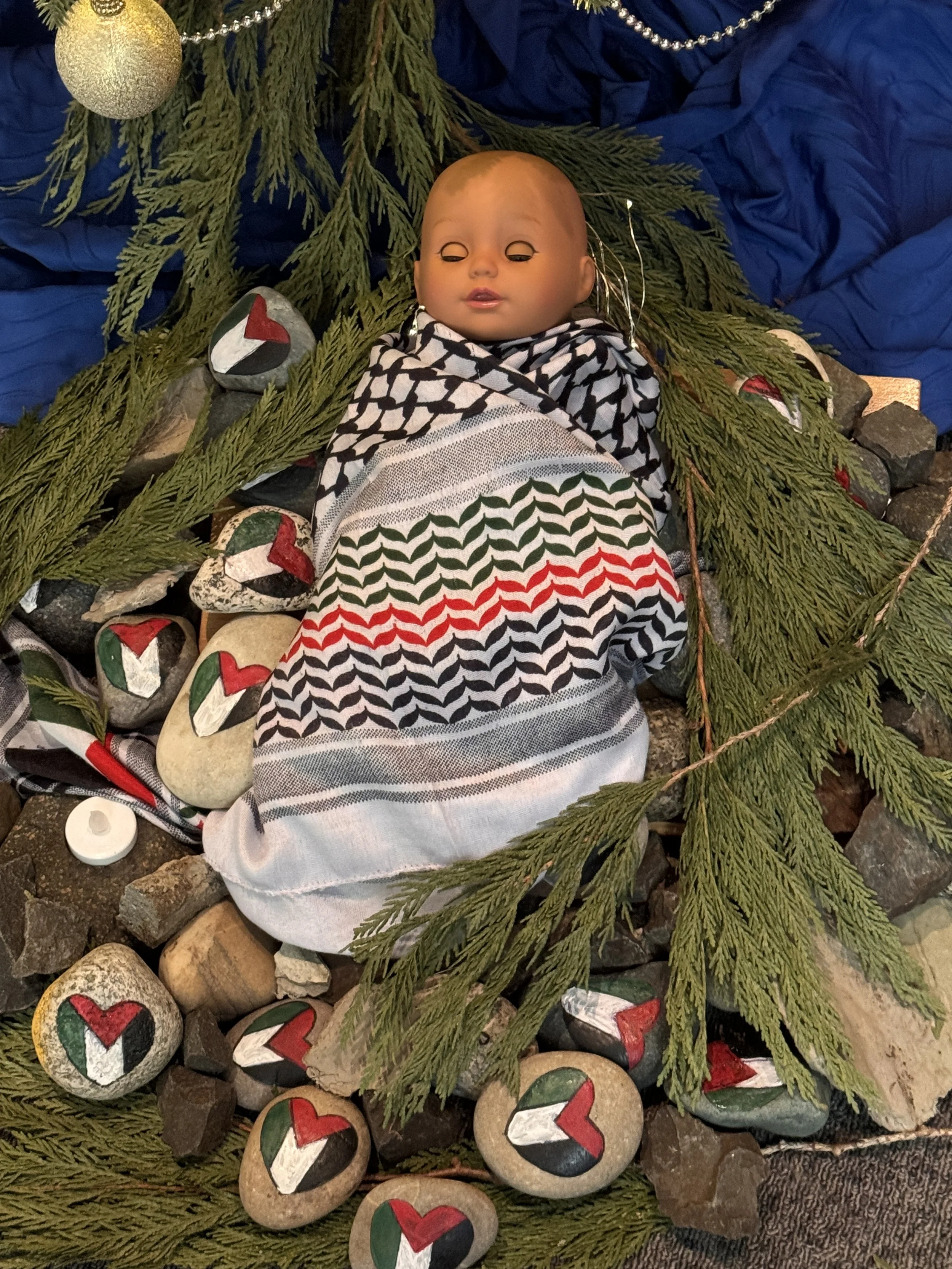
The Evangelical Christmas Church in Bethlehem, led by Rev. Munther Isaac, created this powerful "Christ in the Rubble" nativity scene in December 2023 that has since become a global symbol of resistance and hope. Instead of placing the Christ child in a traditional manger, Palestinians positioned the baby Jesus wrapped in a Kufiyeh [a traditional Palestinian headscarf, typically featuring black and white checkered patterns, that has become an enduring symbol of Palestinian identity and resistance], lying in a pile of rubble.
Rev. Isaac explained: "If Jesus were born today, he would be born under the rubble in Gaza... In Gaza today, God is under the rubble... We see his image in every child killed and pulled from under the rubble."
Theological Significance
The model represents several profound theological truths:
God's Solidarity with the Oppressed - Christ is found not among the powerful but with victims of violence, embodying liberation theology's central insight that God takes the side of the oppressed.
Emmanuel in Our Deepest Pain - It embodies "Emmanuel" (God with us) in our deepest pain and suffering, connecting the vulnerability of the Christ child as a refugee with contemporary Palestinian children under bombardment.
Sacred Space in Destruction - The rubble itself becomes sacred space—not just destruction, but the place where God chooses to be born, where hope emerges from devastation.
Prophetic Resistance - The image challenges comfortable Christianity and forces us to confront where Christ would be found today—not in comfortable sanctuaries, but among those suffering violence.
Trinity Grace's Intersectional Justice Approach
As an Apartheid-Free church, Trinity Grace United Church recognizes that "Palestinian liberation is intrinsically linked to Indigenous sovereignty, inclusive community for all marginalized groups, climate justice, and economic equity." Our commitment to Palestinian solidarity emerges from our understanding that "the systems that oppress Palestinians share roots with those that discriminate against 2SLGBTQI+ individuals, racialized people, and those facing economic injustice." We approach this sacred display as part of our broader witness that "freedom and justice for all peoples are inseparable."
Indigenous and Palestinian Connections: Sacred Colors and Directions
The Palestinian flag's colors—black, white, green, and red—carry deep meaning representing the land, peace, growth, and sacrifice. These four colors resonate with many Indigenous medicine wheel traditions that also use four sacred colors to represent the directions, seasons, stages of life, and spiritual wholeness. While specific colors vary among Indigenous nations, many traditions include combinations of red, black, white, and yellow or other earth tones.
This parallel speaks to how colonized peoples across the globe have maintained spiritual connections to land and cosmic order through color symbolism, seasonal cycles, and directional awareness. Both Palestinian and Indigenous communities have used these sacred frameworks to maintain cultural identity and spiritual grounding under colonial occupation.
As we gather on Musqueam, Squamish, and Tsleil-Waututh territories, we recognize these shared experiences of land-based spirituality and resistance to displacement that connect Palestinian and Indigenous peoples across the world.
From Kairos Palestine 2.0: "Faith in a Time of Genocide"
In November 2025, Palestinian Christians released Kairos Palestine Document 2.0, updating their 2009 document for our current moment. They write:
"We live now in a time of genocide, ethnic cleansing and forced displacement unfolding before the eyes of the world. This moment demands from us a new stand, one unlike any before it... To hold on to faith and hope is resistance. To pray is resistance. To safeguard the holy places is resistance. To preserve social peace is resistance." (§2 and §2.3)
This document emerges "from the heart of the assault on Gaza—mass displacement, starvation, the destruction of every sector of life, and the burial of families under rubble" as "a cry of hope in a time of genocide."
Living Stones: The Palestinian Christian Tradition
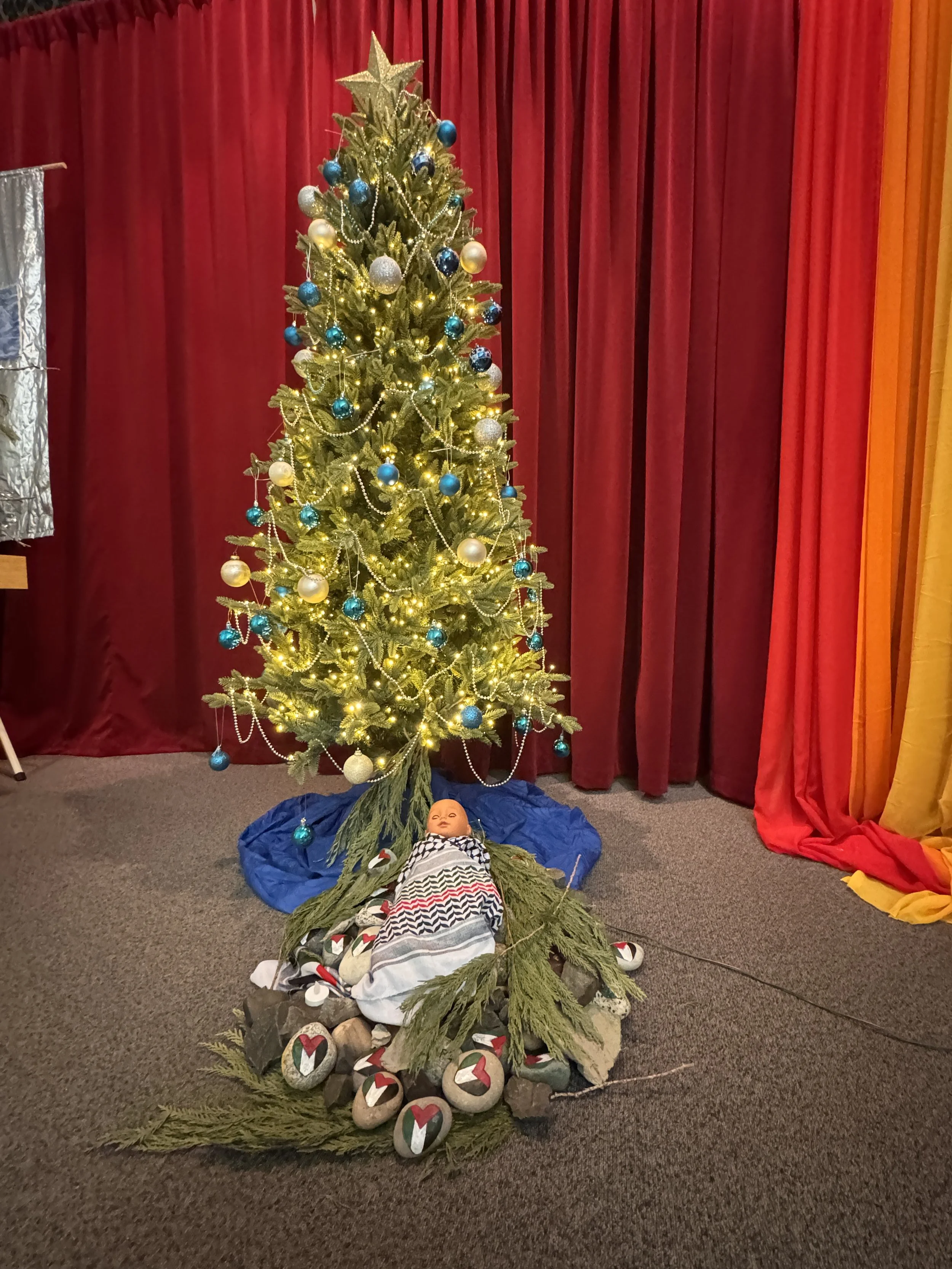
When the Apostle Peter wrote about Christians as "living stones" being built into God's spiritual house (1 Peter 2:4-5), he was writing to communities facing persecution. Today, Palestinian Christians call themselves "living stones"—they are the living continuation of the church where Jesus walked, prayed, and was crucified and resurrected.
For over 2,000 years, through Roman occupation, Byzantine rule, Crusades, Ottoman Empire, British Mandate, and now Israeli military occupation, Palestinian Christians have maintained their presence in the Holy Land. They are not just archaeological artifacts but living stones—breathing, praying, suffering, and hoping members of the Body of Christ.
When you take a stone from this rubble, you join this ancient tradition. You become a living stone not just for remembrance, but for active solidarity and justice.
Taking Your Stone: A Theological Act
If you feel comfortable, take a stone from this holy rubble—not as a relic, but as a covenant commitment.
This stone you carry represents:
A commitment to remember - that God chooses to be born among those who suffer, that Palestinian children's names and stories will not be forgotten, that the cries of "How long?" demand our sustained attention.
A pledge to advocate - to continue to elevate Palestinian voices in your communities, to challenge systems that enable oppression, to speak truth about what you have witnessed here tonight.
Becoming a living stone - joining the Palestinian Christian tradition of sumud (steadfastness), becoming part of God's house of justice where no stone is left unturned in the pursuit of liberation for all God's children.
A symbol of hope for liberation - for Palestinians to live with dignity on their ancestral land, for Israelis to find security through justice rather than domination, for all children in the region to grow up free from fear.
A call to continue the work - until every child can sleep safely under their own vine and fig tree, until the rubble becomes foundation stones for a just peace, until the question "How long?" gives way to "At last."
As Rev. Munther Isaac reminds us, the rubble is not the end of the story. From this destruction, hope rises. From these stones, new possibilities are built. From our commitment, liberation draws near.
The Christ who was born in rubble calls us to help build the world where no more children will be born under bombardment, where no more mothers will search through debris for their babies, where peace flourishes and justice flows like a river.
Take a stone. Become a living stone. Carry the commitment. Continue the work.
For more information about Palestinian Christian theology and the Kairos Palestine movement, visit kairospalestine.ps
To learn more about Trinity Grace United Church's intersectional justice commitments, visit tgucvan.com/apartheidfree