
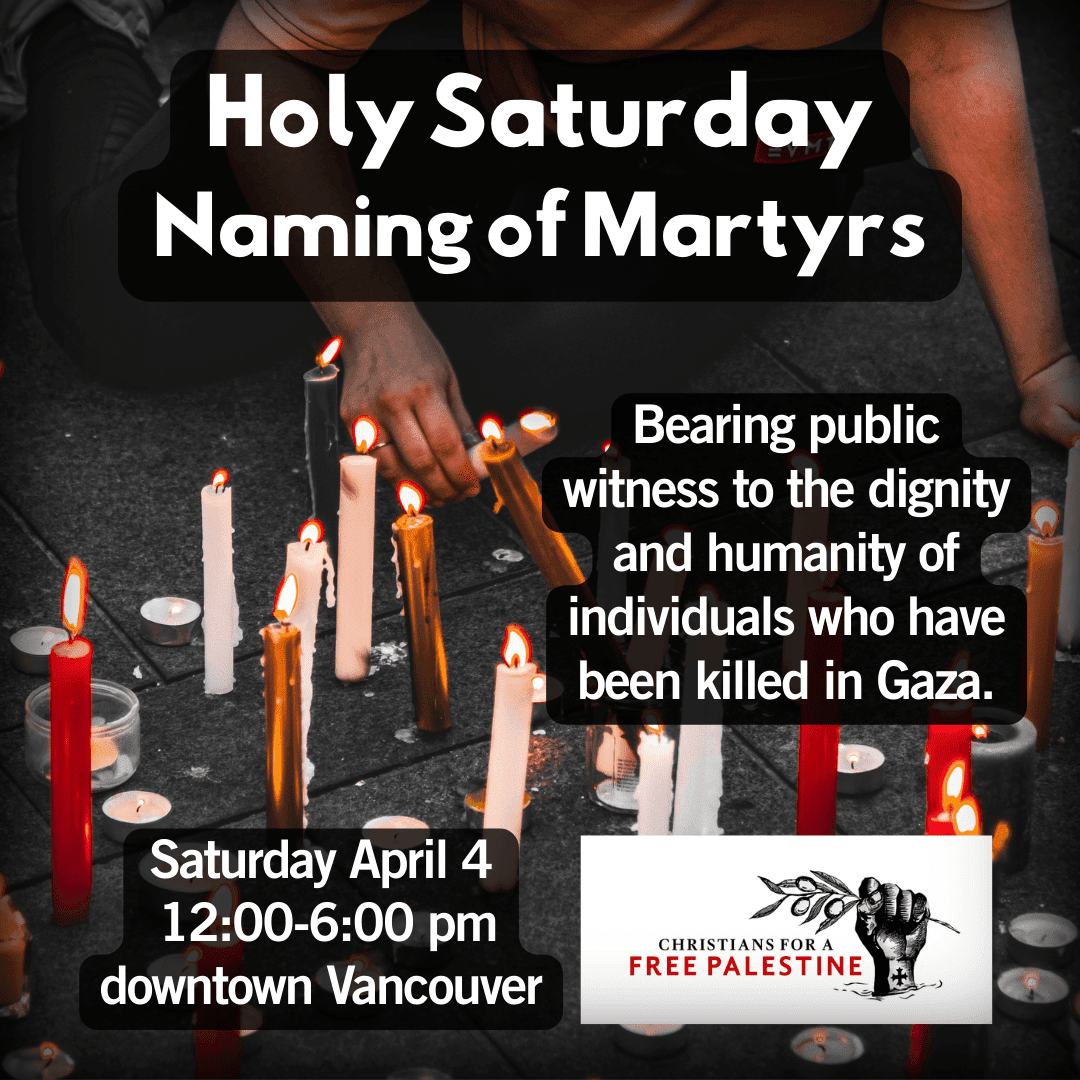
This is a collaboration public event.
On the afternoon of Saturday April 4th, 12:00-6:00 pm, in downtown Vancouver (exact location TBD), we will host a public vigil station where we will read aloud the names of recent martyrs in Gaza. Even with six hours of constant reading, we will only cover a fraction of the list of people killed since October 7 2023 - it would take almost 6 days of non-stop reading to recite all of the names confirmed by the Ministry of Health, and even longer to include the thousands of names of people still missing under the rubble.
Powerful Visuals
Killed in Gaza (Palestine Datasets)
Remember their names (Visualize Palestine)
Know Their names (AlJazeera)
Martyrs (Palestinian Central Bureau of Statistics)
How reliable are the death tolls from the Palestinian Ministry of Health in Gaza?
-
The word martyr comes from the Greek martys and the Arabic shahid — both meaning, at their root, simply "witness." In the early Church, a martyr was someone who bore witness to Christ with their very life, and the Church preserved their stories through art, liturgy, and communal memory across generations. But in contexts of ongoing collective suffering — from Latin America to Palestine — Christian theologians have expanded this understanding. Liberation theologians like Jon Sobrino speak of "crucified peoples," recognizing that when entire communities are subjected to violence, the innocent who perish bear witness not through a voluntary act of individual heroism but through the sheer weight of their unjust suffering. In the Palestinian Christian experience, this resonates deeply: the dead are not mere casualties or statistics in a military report, but moral witnesses whose lives and deaths testify to injustice, to the cost of occupation, and to the truth that the powerful would prefer to remain hidden. The theological heart of martyrdom, then, is not glorifying death but insisting that no life lost to violence is meaningless. Following the pattern of Christ — the ultimate victim transformed into sacrifice — communities of faith can choose to remember their dead not as fuel for revenge but as an intercessory offering for the sake of peace and a more just future. To hold the memory of a martyr is to refuse the erasure of their story and to commit oneself to the world for which they should have lived.
For further reading: John S. Munayer and Samuel S. Munayer, "Palestinian Theology of Martyrdom," in The Cross and the Olive Tree: Cultivating Palestinian Theology Amid Gaza (Fortress Press, 2025).
-
We know that reflecting for even a few seconds on a single name can be an act of prayerful recognition that this person was fully human, uniquely valued by God in all their individuality. Bearing public witness to those who have been killed is an act that recognizes their dignity and resists dehumanization and abstraction. On the in-between, liminal day of Holy Saturday, we entrust each martyr we name to the One who laid down his life in solidarity with the suffering, to liberate all people.
-
This is a collaborative event that is led by Christians for a Free Palestine (Vancouver) and the participating churches from the Lower mainland.